
Gaps and opportunities
This summer, we chatted with Brad Hutnik, Wisconsin DNR Forest Ecologist/Silviculturist, about the climate-smart demonstration areas at the Forest Exploration Center. Within four demonstration areas, we’re addressing and measuring the effectiveness of climate-smart forestry adaptation strategies. The demonstrations are part of a broader education and outreach mission to help us learn how to identify and prioritize climate change vulnerabilities, and to help professional and private audiences learn how to implement planned adaptation actions in their own forests.
We’ll share Brad’s wisdom over the rest of this year. First up, we discuss our strategies of opening up the canopy and diversifying the size and age classes of the trees in the forest as an insurance policy against climate change and environmental disturbance.
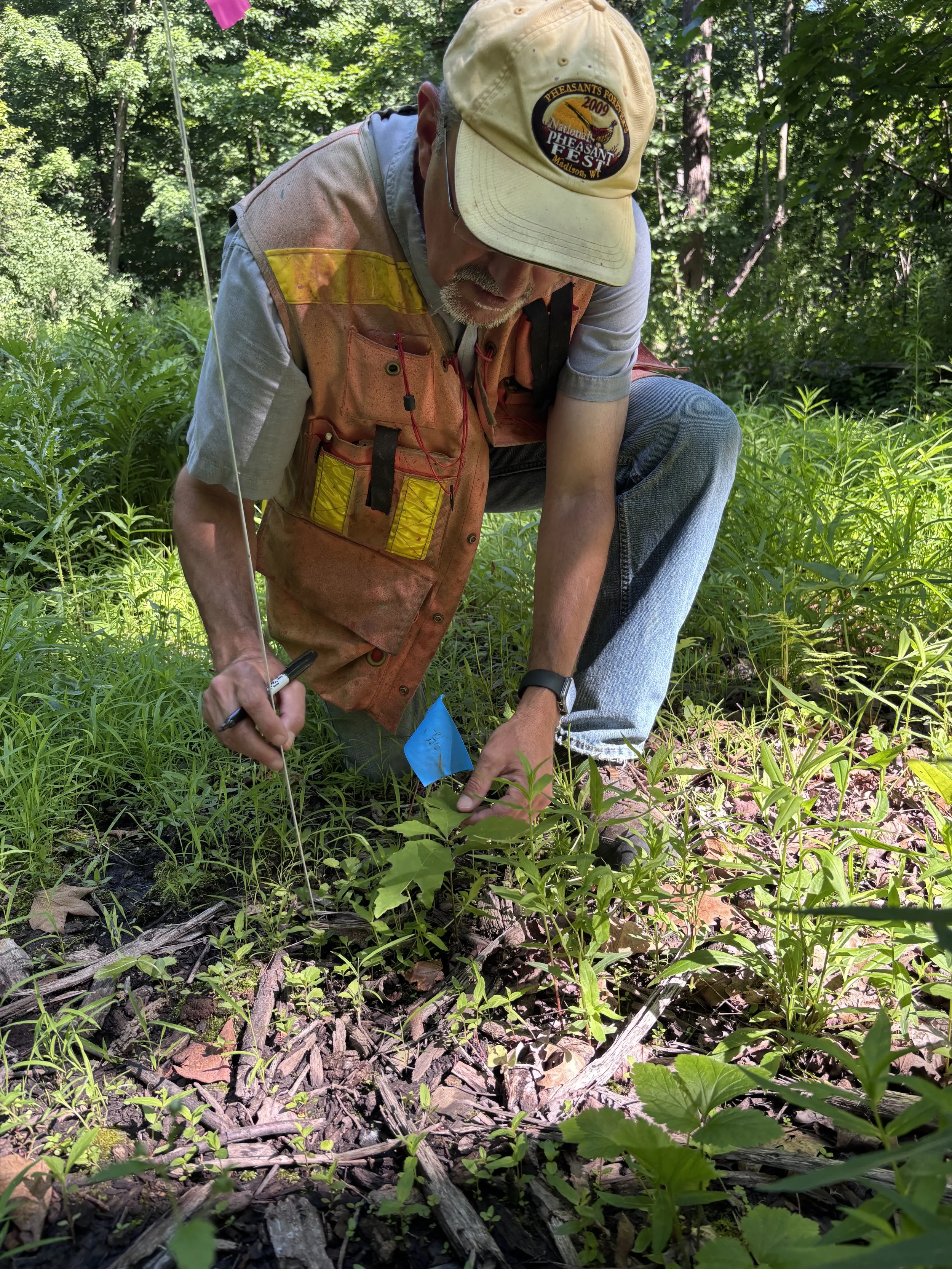
Brad Hutnik monitors a young seedling
At the Forest Exploration Center, we have this great diversity of species, with sugar maple, oak, and other tree species. Northern hardwood forests are dominated by sugar maple and basswood, or shade-tolerant trees. They're much more common in northern Wisconsin and northern parts of the US. But the FEC has a combination. We don't really call it southern hardwood, but the equivalent would be what we would call oak or central hardwoods. Oak are predominantly a southern species. We do see oak in northern Wisconsin, but southern Wisconsin would have been dominated by oak, which require more sunlight.
What we lack, though, is a diversity of size classes and ages within the forest.
That can be a problem ecologically, because certain plants and animals may key in on age classes as a habitat component. And if an age class isn’t there, then it's not good for those species. For instance, we know from studies that some birds are “area-dependent” species. There are species that like to live in large blocks of forest. But when they're young, or when they have young, they'll take those young into these openings with younger age classes, because there are more insects to eat in those areas, or things to glean off of leaves.
So if you don't have those openings, even though you might be preserving this larger block, you might be limiting the diversity of bird species simply because you don't have that diversity of habitat niches present.
It's a climate change thing, too. If we have all old trees it’s kind of putting your eggs in one basket. And if we have a woods that's all old trees, you could have something that might not be a problem in lots of other places, but it'll be a huge problem in that woods.
That's basically what happens with, for instance, oak dieback. There are 140-, 150-year-old oaks and nothing coming behind them. Or when you have oak wilt, and you have all these trees that are really close together, and old. That doesn't occur naturally, so something that would have been a minor disease in natural stands suddenly becomes this major disease, because it's not operating the way it would have historically.
At the FEC, we have an age distribution that's skewed to older trees. We have trees that are approaching 200 years old in some places. We're missing that component of younger trees, in the 5- to 10-inch size class, that really should be much more common in a site like that. It's really an insurance policy. If something happens to a bigger tree, you have a younger tree that can take its place.
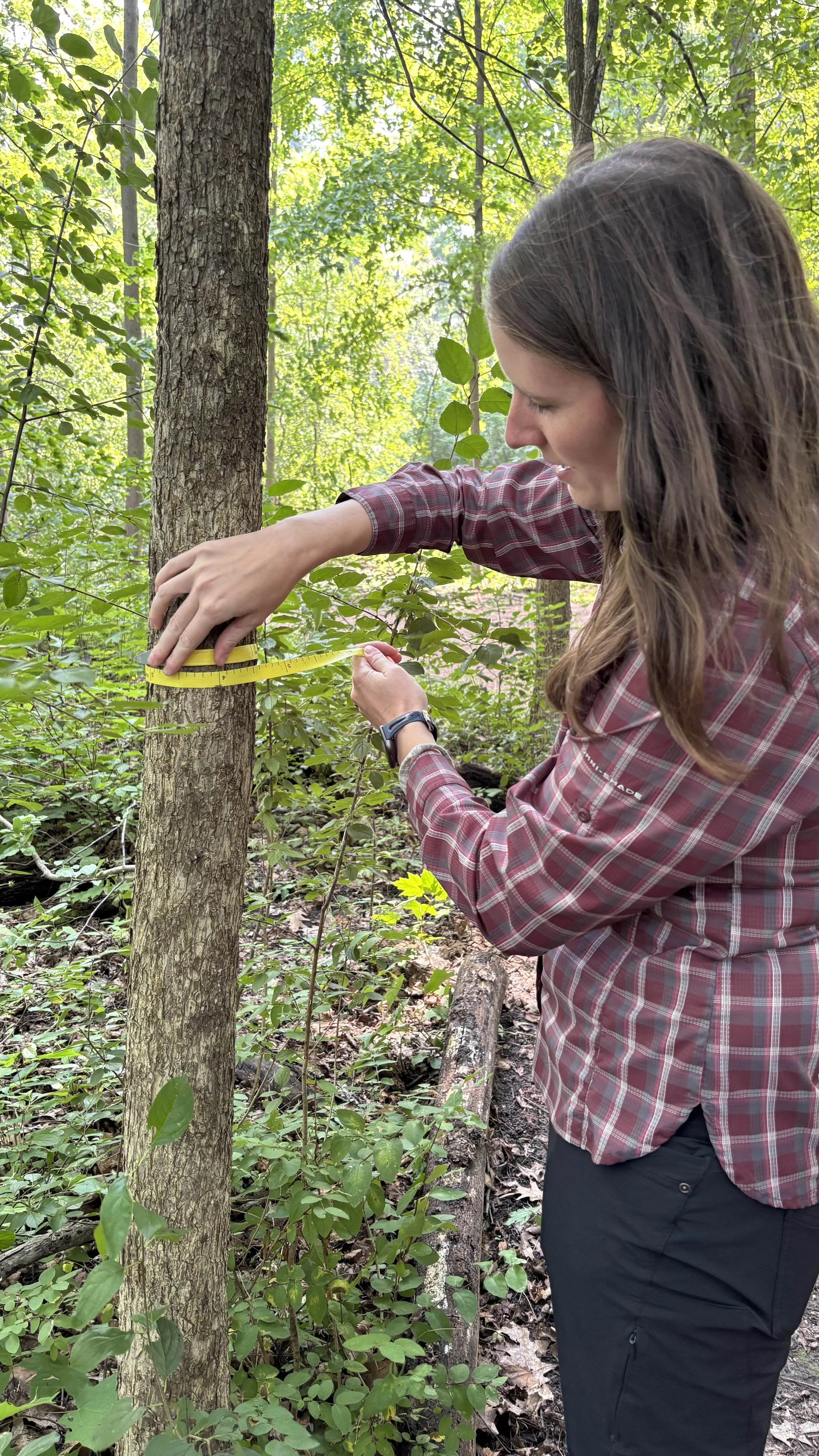
Measuring trees during the “Resistance, Resilience, and Transition” educator workshop with LEAF and Project Learning Tree
Naturally, we would have these openings, or we would have little pockets of younger trees mixed into a forest. That’s kind of there, but not to the density that we would expect. And it's related to a lack of disturbance in the canopy, and then deer limiting regeneration underneath it.
Several factors would have led to this size class gap. Grazing would have kept that stand open. Historically, we know from photos that the FEC land was more open and there were many fewer trees in the area. It would’ve been more park-like. And now it’s basically coming back.
Fire, like grazing, would keep regeneration down, too. But it wouldn’t eliminate it. Fire would make them resprout smaller stems.
We did have a fairly dense population of Native Americans in this area compared to northern Wisconsin. And the use of fire to keep that landscape open would have been a tool that they used. And if they were using that tool, regular fire on the landscape supports recruitment and regeneration of oak on the site.
We have trouble bringing fire back into the Forest Exploration Center, because of roads, air quality issues and things like that. We might have to use practices that mimic fire, but don't actually employ those same processes. And it's the same thing we did with creating gaps in the canopy. We weren't waiting for a tree to blow down to create the gap; we created the gap. We had a lot of trees that were in a smaller size class, so we did a midstory removal, and then we created conditions at the soil level for those acorns. It'll look more like how it would if fire had played a role.
We never know the disturbance that's going to be coming. But what does happen is that the systems become adapted to whatever that level of disturbance was most common in these sites. In northern hardwood forests, large trees or older trees would have died, been blown over, or just died naturally, and they would have released regeneration underneath them, and there would be multiple age classes present at any point.
And so, in the gaps that we took advantage of for these climate-smart strategies, we basically dropped some trees, and we found advanced existing regeneration. We're letting that grow, and we're actually creating that new age class. And now we are monitoring the amount, the number, and the height of different species of trees in each of the openings.
We’re measuring whether these openings are successfully recruiting and creating trees that are going to form that next age class, or that will be part of the canopy in the future. Success there would simply be, “are trees regenerating in this area and bringing it forward? Is there sufficient regeneration?”
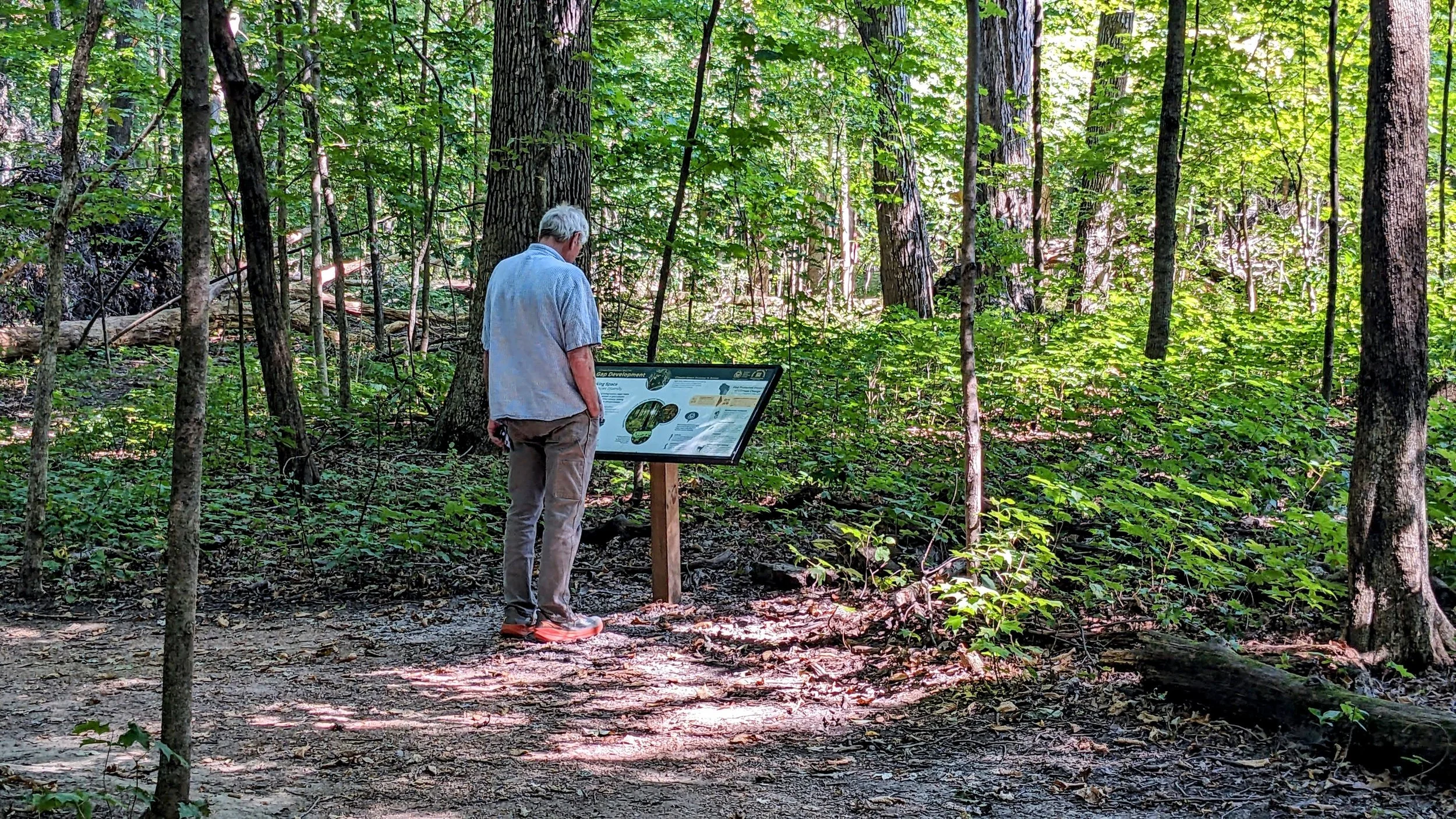
The Gap Development interpretive panel, along the main trail loop, explores some of these concepts in depth.
And we’re seeing that, yes, the openings we've established are successful. The larger the opening, the greater the diversity of tree species, and probably the faster the trees will grow. As it becomes more shaded, then you'll only have shade-tolerant trees, like sugar maple, present. And then they might not grow as fast because they won't simply get as much light as they would from other places.
In some ways, restoration looks a lot like adaptation because you're creating lots of opportunity for different things. You're creating lots of different niches for plants that are naturally adapted to grow in those situations.
And that adaptation is one of the reasons the Forest Exploration Center is amazingly free of invasives. Yes, we do have buckthorn, we do have honeysuckle, we do have garlic mustard, but it's not nearly as degraded as some of the other woods in the area.
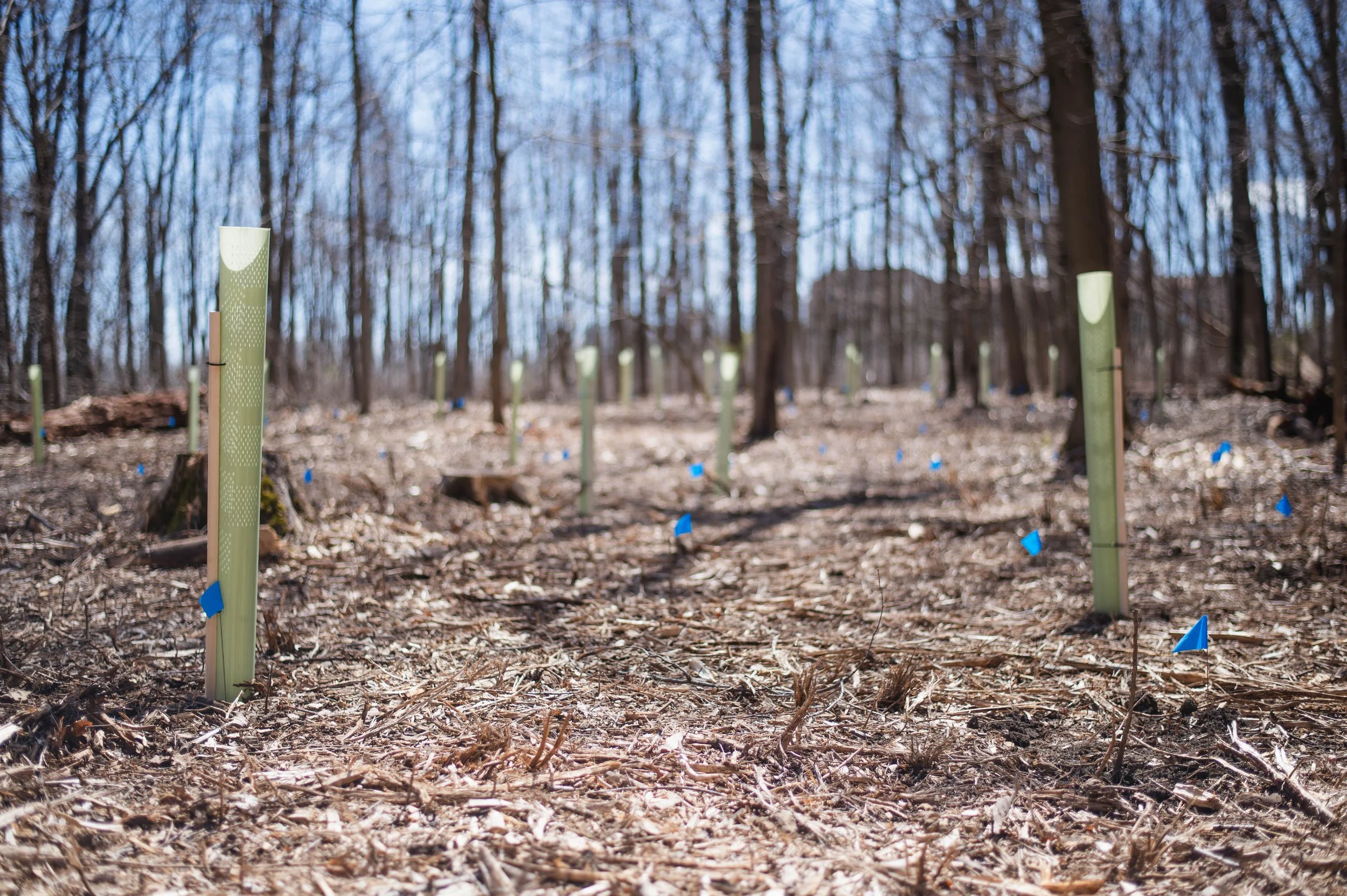
2024 Climate Adaptive tree planting.
If you have native species, they're usually adapted to the natural disturbance. Whatever would have been the natural disturbance in the woods they would have occurred in historically, they'll do really well with that. If we can, we’ll mimic that as a part of our management.
That's a climate adaptation, restoration, and also sustainability.