
Deer in the Urban Forest
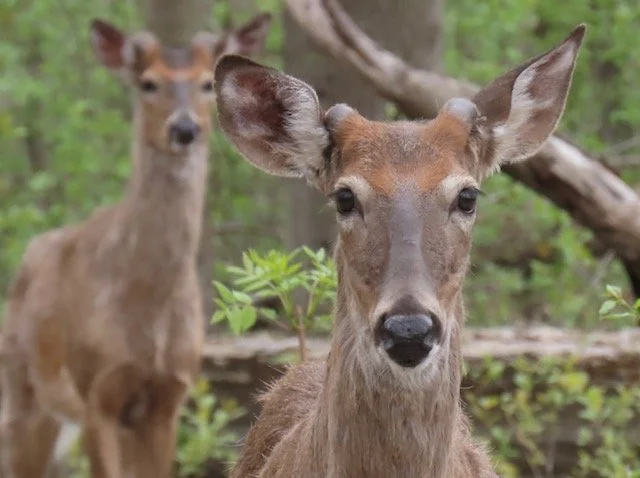
Image of two bucks in the forest by Greg Beck, April 2026.
This summer, we chatted with Brad Hutnik, Wisconsin DNR Forest Ecologist/Silviculturist, about the climate-smart demonstration areas at the Forest Exploration Center. Within four demonstration areas, we’re addressing and measuring the effectiveness of climate-smart forestry adaptation strategies.
In part two, we dive into the historic and present impact of White-tailed deer on the Forest landscape. Are they beneficial? Harmful? Or simply an integral part of the landscape?
Read on to learn from Brad about what we know—and how we’re discovering more about the relationship between deer and forests.
Q: We get a lot of questions about the deer exclosures. People like seeing the deer, but what can you tell us about their impact on the Forest?
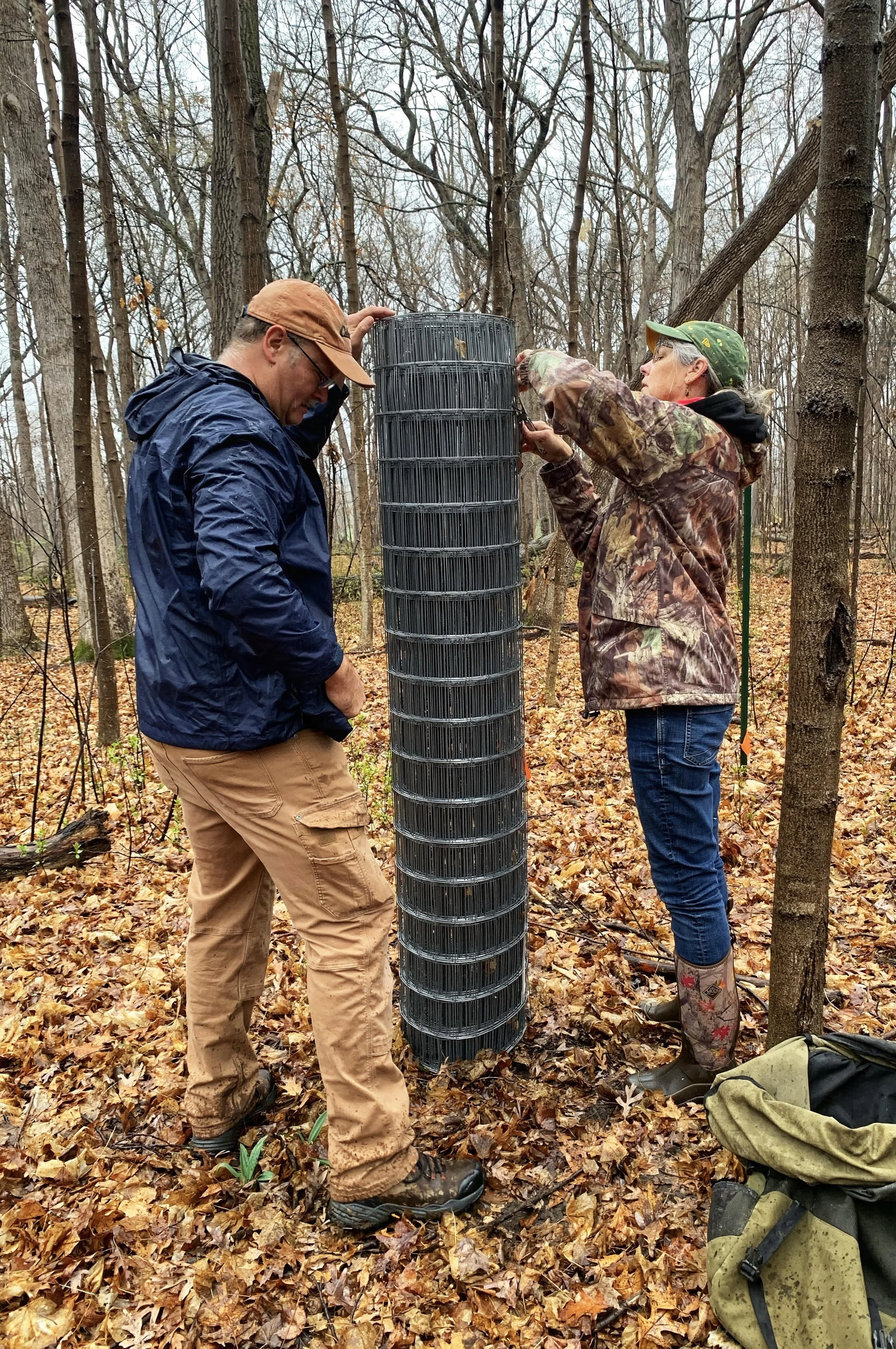
Installing the deer exclosures in 2021
Brad: The thing that I've really learned from the exclosures that we've had at the Forest Exploration Center is that sometimes your perception of reality isn't necessarily reality. It's just your perception.
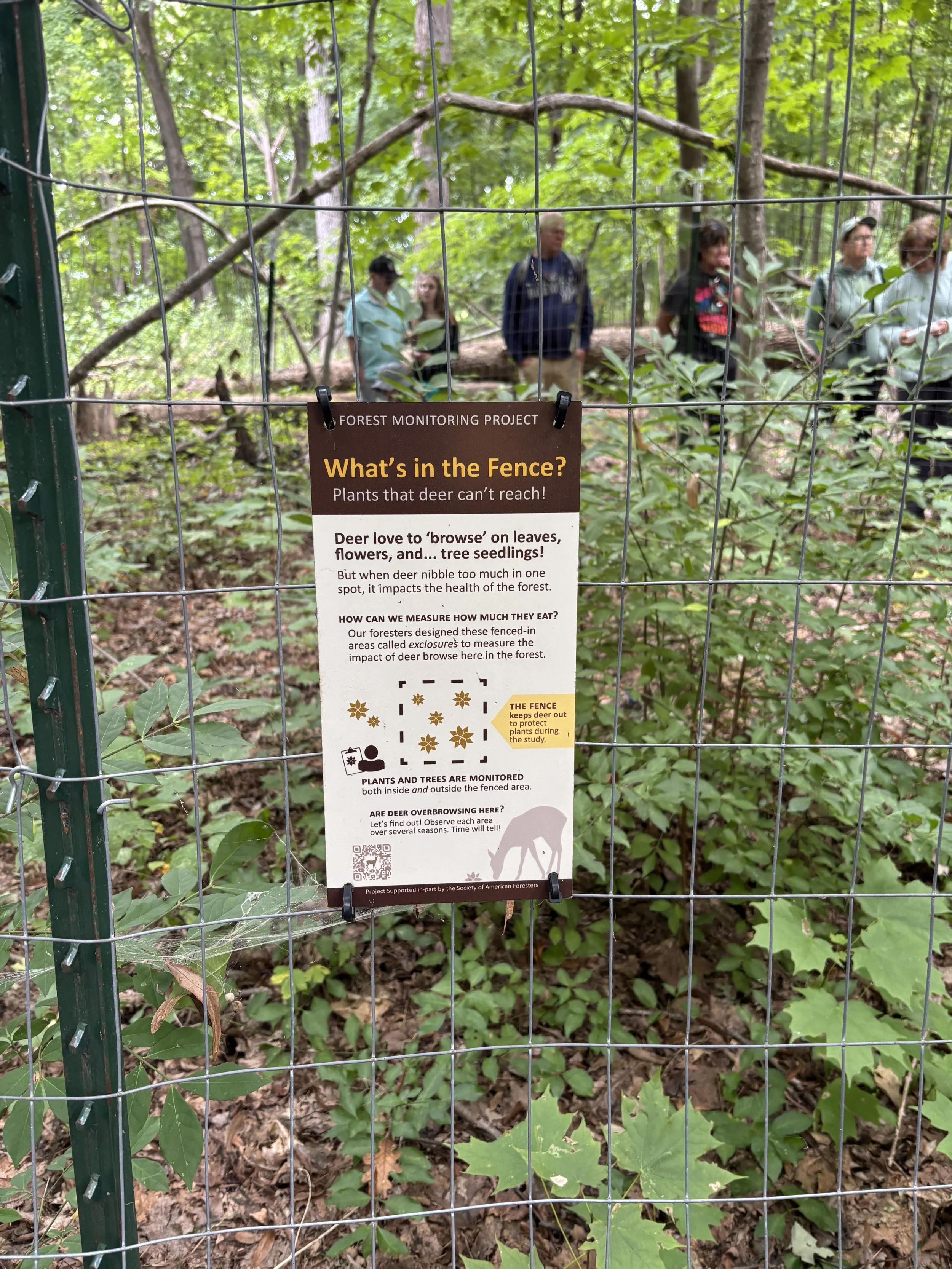
It was during COVID when we put those up, in 2021. We had young, successful regeneration in lots of different places, and the thought was, let’s see what the difference is, between what’s happening with and without deer.
We put those two exclosures, one where we already had existing regeneration, and then we put one further in the woods, in the shade, where we didn't have any regeneration. And we wanted to document the difference between those.
What was mind-blowing to me was how fast sugar maple grows when it's not being browsed on that site.
The stuff that’s growing inside now, you look up at it. It’s only been six years, but we’re actually looking up. Those maples were growing two-and-a-half to three feet a year at times. You don’t see the densities and numbers like that any place else in the woods.
What we’re perceiving as normal is just that regeneration takes a long time, and we perceive it as a slow-growing species on that site. The truth is that it’s fast-growing, but it’s being held back by deer. Deer aren’t eliminating the regeneration. They’re limiting the height growth and the density of that regeneration. So it was really interesting to see what that difference looks like.
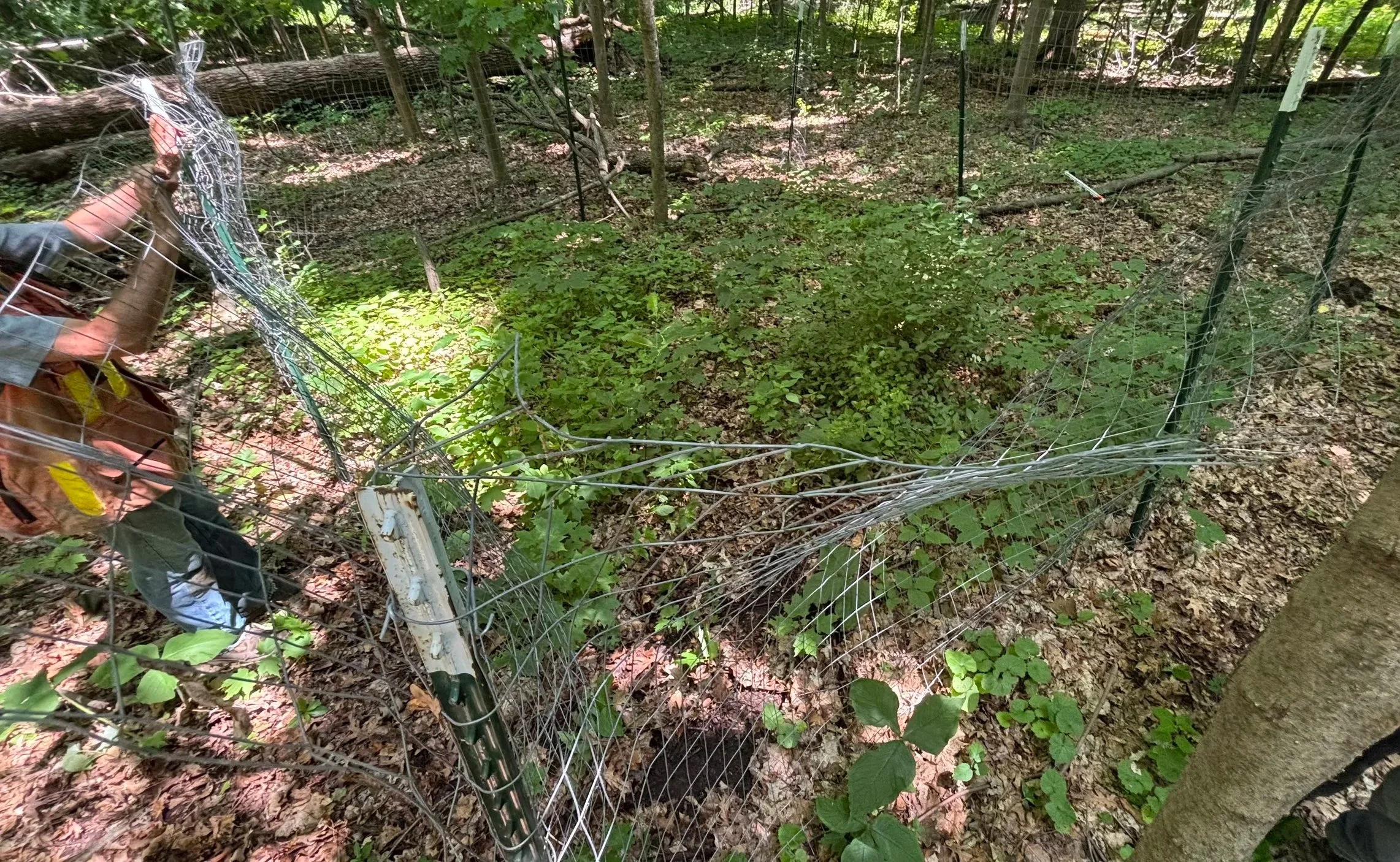
Green vegetation inside the exclosure, July 2025
What’s also really interesting is that the one further in the woods…there’s not a ton more regeneration in that plot. There is some regeneration, and the plants are coming back in that area much quicker, and it looks like a green postage stamp compared to the woods around it. When we were out there, we were seeing trilliums, tall trilliums inside the deer exclosure. If you look in the woods around that, you just don’t see trillium.
To me, that was really good evidence that the floristic, or plant, diversity of the woods, is limited by having a lot of deer there. And the deer are limiting the height growth of the species that are present or regenerating naturally.
The exclosure in the woods is still good and doing its thing. We’re still seeing regeneration coming into that. We could probably move the one closer to the trail, and start another one to monitor impact somewhere else as we go forward.
At 25 years in forestry, when you see stuff like that, it still makes you go, Oh! You learn something new every day. I would have never guessed sugar maple grew that fast on that site. At other places in the state, we cut down sugar maple that are in the shade that are only an inch in diameter, but might be 40 to 50 years old. The shade will slow them down.
The first impulse, in general, if trees have to allocate their growth, is to put that into height first, before diameter. The height gets them to the light, and they’re competing with their neighbors.
And that’s where oaks sometimes lose the race, because they put resources into their roots. Oaks are built for having to re-sprout when a fire comes through, or when something gets knocked down, and they need to be able to come back very quickly. Sugar maple aren’t used to that.
Q: Would you say that deer, then, have a negative impact on the Forest? Are there similar sites, not necessarily urban woods, but other places where there are no deer that you can compare the biodiversity of the forest to?
Brad: We don’t want to say that something is negative or positive. We just talk about the impacts of it. Once we start to talk about the “good” and the “bad,” then it shades what we say and think. And it also makes us, maybe, less open to some of the data when it comes through, because it’s not going to fit our view of something being good or bad.
In Wisconsin, it would have been very odd to have no deer in a place. So an exclosure, in a way, is creating an abnormal situation where there's no influence of deer at all. And then if you have too many deer, you can wipe out plant species, you can eliminate regeneration, you can cause all sorts of different problems with that, too. Plants can take browse, they just can’t take an excessive amount of browse. They can’t be browsed down to nothing and then expect to come back.
Research has shown that somewhere in that middle, if you have browsing, not too intense but not too light, you actually can increase species diversity in those areas because it's kind of an additive disturbance that will favor certain species, and can be actually a good thing for diversity in the woods. It’s a balance, right? How many deer do you have, and how much food do you have available?
If you’re thinking about an urban landscape like this, there’s a ton of food available to deer. It’s very common to go to the Forest Exploration Center and see a deer. And because they linger there a lot and want to spend time there, that’s why their impact is going to be a little higher in that particular spot on the landscape as opposed to others.
But I wouldn’t call the deer negative. Pre-settlement, in southern Wisconsin, we likely had something like 20 to 50 deer per square mile. That’s quite a few. So these were really rich sites. They would have had a lot of vegetation on them. That landscape looked a lot different, and there were different limiting factors on deer than we have now. Now, in that environment [of the FEC], the biggest limiting factor on deer is probably cars.
And we can’t blame deer for every problem. Before the 1930s, there were cows in those woods, too. We’re still seeing the impact of cows in those woods, 100 years later. Some species were favored because cows didn’t want to eat them, or they had thorns, or, like chokecherry, are poisonous to livestock.
Q: How can the deer exclosures inform our research and restoration efforts?
Brad: Some of our future work for climate change, for forest health, for restoration, might be reintroducing some plant species that we don't see at the Forest Exploration Center but suspect should be on a site like that. That will be a place where the Forest Exploration Center can be a little pioneering, too, because what we'll be doing is kind of an enrichment planting of species.
We've already done it with the trees. We've enriched the tree regeneration with different species. This would be looking at different plants, and then asking, Can they regenerate? Can they persist with the amount of deer that we have, if we get a seed source available there now?